Your TMS decides how to ship. FlowPath decides whether the shipment should exist on this path at all.
An AI-first dispatch decisioning and logistics control tower for process and discrete manufacturers. It sits above your ERP and below strategic network design.
The optimiser decides. The agent handles everything the optimiser cannot see.
Mixed-integer network flow and vehicle routing are solved problems, so the differentiator is everything wrapped around them. FlowPath's agents do the four jobs a solver structurally cannot: elicit the tacit constraints that live in planners' heads, explain and defend every recommendation to a sceptical branch manager, interpret free-text overrides into model changes, and re-plan from a natural-language instruction. The solver stays the decision-maker while the agent makes the data and constraints ready, which is the exact gap BCG's 2026 assessment blames for most planning underperformance.
Who it's for
Mid-to-upper-mid manufacturers with $200M - $2B revenue, freight spend of $10M or more a year, and a three-plus-echelon network (15+ depots, 300+ distributors) where dispatch planning still runs in Excel and a person, not a system, decides which depot serves each order. Electricals and consumer durables are the sharpest fit, and the data model admits cement and steel.
Typically championed by
The shift
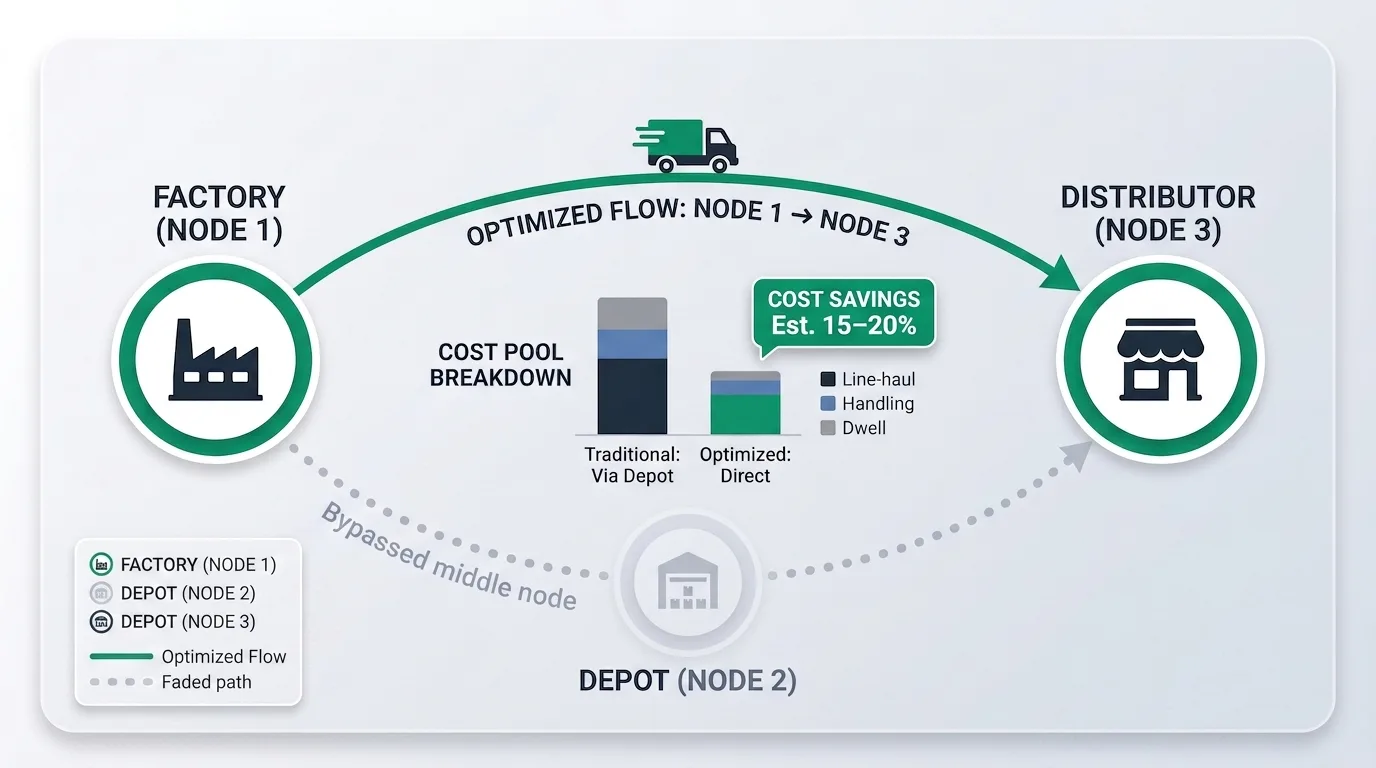
Your distribution network was designed under legacy tax rules and never redesigned. The ERP still routes every unit through a warehouse in every region because the master data says so. Your TMS optimises the route from a depot to its dealers, and your network-design study decided the warehouse map two years ago. Nobody decides, today, order by order, whether this shipment should skip the depot at all. The saving stays invisible because four of the five real cost pools (handling, dwell, lead-time and dead freight) are never attributed to the routing decision that caused them.
The flow path stops being frozen master data and becomes a daily, defensible decision. Freight savings that were invisible because they hid in four unattributed cost pools become a named, order-by-order number. The branch manager who used to quietly reject every recommendation keeps his sales credit and sees his cooperation counted, so the saving actually survives contact with the organisation.
How it works
FlowPath treats the flow path itself as the decision variable. It reconstructs your real landed cost across all five cost pools from your own dispatch history, then computes what the same orders would have cost under alternative paths and clubbings. A tax-feasibility filter runs before scoring, so no recommendation that breaks local tax, transfer-pricing or compliance rules ever reaches you. Every recommendation carries its counterfactual in currency and days, the cost pools it moves, a confidence score that admits what was inferred, and a shadow-credit entry so the bypassed depot's incentive stays whole.
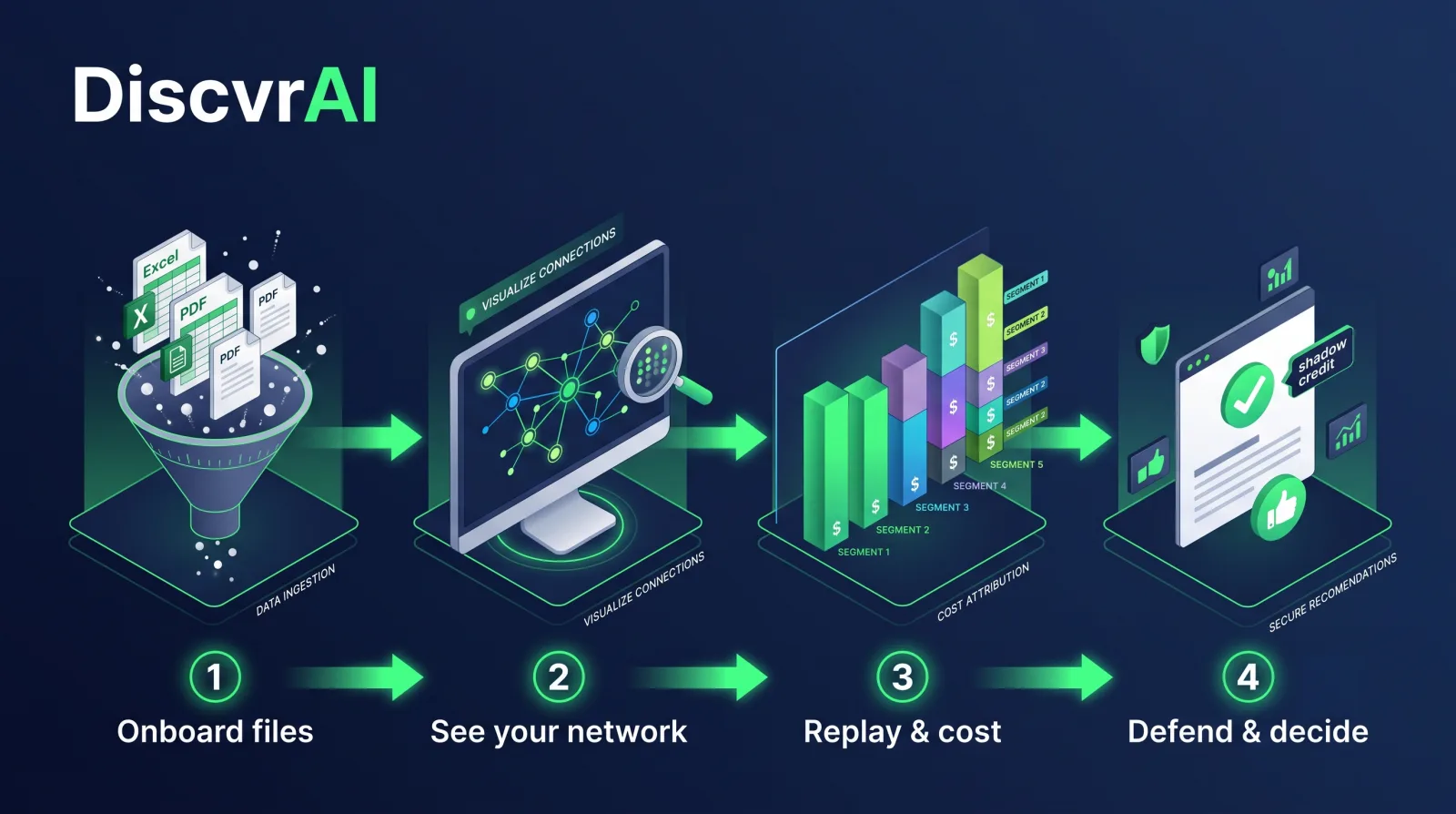
- Step 1
Onboard the messy pile
Upload seven Excel files and a folder of rate-card PDFs. The onboarding agent infers schemas, geocodes free-text addresses, parses rate cards into executable cost functions, and infers missing SKU cube data by regression. It produces a Data Readiness Report that finds money before the optimiser runs once.
- Step 2
See your network, and your real distances
Your network appears on a map, with nodes sized by throughput and lanes by flow, and contracted vs actual road distance flagged. Several prospects buy on this single report: the km you pay for but don't drive.
- Step 3
Replay the past, cost pool by cost pool
Six to twenty-four months of dispatches are re-costed across line-haul, handling, dwell, lead-time and dead freight. Each is then compared against the cheapest tax-feasible path and clubbing, order by order, with the specific shipments named.
- Step 4
Defend it to the person who'll object
Each recommendation explains itself in the reader's language, shows its counterfactual, and preserves the branch manager's sales credit. It will even refuse to recommend a saving that breaks a downstream service level, because being trusted is what you're actually buying.
Modules & sub-capabilities
Network Onboarding & Data Readiness
From messy Excel and scanned rate-card PDFs to a validated, distance-resolved network graph in under five working days. The Readiness Report names unresolvable addresses, missing SKU cube data by dispatch volume, and diesel-escalation clauses you aren't currently claiming against.
Road-Distance & Rate-Card Engine
Self-hosted routing computes the full N×N road-distance matrix (not haversine, which is 20-35% wrong vs actual road distance), cross-checked against your own lane history. Rate cards become executable cost functions traceable to the exact contract clause, a retention feature when a transporter disputes a bill.
Tax & Compliance Feasibility Engine
Runs before the optimiser scores anything. It handles bill-to/ship-to structuring, place-of-supply rules, transfer-document validity computed on the full clubbed-route distance, and the tax-credit and working-capital impact of every option, so tax-infeasible plans never reach a human.
Five-Pool Savings Ledger
Line-haul, handling and transit damage, inventory carrying and dwell, lead-time penalty, and detention and dead freight. Each recommendation attributes its saving across all five, against a baseline methodology agreed in writing before the pilot.
Sales-Credit Neutralisation
The political layer, productised. A shadow-credit ledger keeps the bypassed depot's incentive whole, a bypass budget caps how much of any node's volume can be diverted, and each branch manager's dashboard frames the freight saved by his cooperation as his contribution. No competitor markets this.
Multi-Echelon Inventory Guard
Every bypass is scored against its service-level consequence at the depot it skips, with safety stock recomputed under the new demand-pooling. FlowPath is the only tool that will refuse a saving because it would cause a stockout six weeks later, the failure mode that kills internal Excel models.
What-If & Scenario Copilot
Natural-language scenarios over live data: "what if fuel goes up 8%", "what if we close the regional depot", "what happens if a major corridor is blocked for three days". Each is re-optimised with a delta report, at daily cadence, where incumbent network-design tools run annual studies on stale extracts.
Freight Bill Audit (Settle)
Parse the contract, match to the transaction, compute what's owed, assemble the evidence pack. Overcharge rates of 3-8% on freight bills are common. It is the highest-ROI, lowest-controversy module in the tower, and the bridge to DiscvrAI's recovery-engine products.
Trust & governance
Enterprise buyers ask what stops agentic AI going wrong, so the guardrails are the product. In v1 FlowPath makes no autonomous dispatches, modifies no hard constraint on its own, and writes nothing back to your ERP without per-recommendation opt-in. Every amount in an explanation traces to a computed field, enforced by a template-with-slots architecture rather than free generation, so numbers are never fabricated. Ingestion starts as file exports, with no credentials and no security review, and moves to live integration only after trust is earned.
The five cost pools nobody itemises
When a company says "our freight cost," it usually means pool 1. The bypass decision only looks compelling once pools 2 to 5 are counted, and they never are, because they sit in different departmental budgets.
1 · Line-haul freight
Rate × distance × weight/volume, per leg. Visible in the ERP. The only pool everyone measures.
2 · Handling & transit damage
Every touch at a depot costs a loading charge plus a breakage rate, rarely attributed to the routing decision that caused it.
3 · Inventory carrying & dwell
A four-echelon path can add 8 to 20 days of dwell versus a direct shipment: working capital, plus markdown risk on seasonal goods.
4 · Lead-time penalty & lost sale
A distributor who waits 11 days instead of 4 over-orders safety stock, or buys the competitor. It shows as a revenue effect, never as a logistics cost.
5 · Detention & dead freight
Trucks waiting at gates and depots, plus dead freight, the charged capacity you didn't use. Real money, invisible on the freight line.
All five, counted together
FlowPath's savings ledger has five lines, not one, and every recommendation attributes its saving across all of them, so an echelon bypass is provably worth it, or provably not, instead of a guess.
Where every other category stops
| Category | Where it stops |
|---|---|
| Last-mile / route optimisation | Takes the flow path as given. It finds the best route from depot D to these 40 dealers, never whether the order should pass through D at all. |
| TMS / dispatch execution | Consolidates within an origin's own order pool. The network structure is master data, not a decision variable. FlowPath layers above your TMS, not instead of it. |
| Freight procurement | Lowers the price per km. It does not reduce the number of km. |
| Strategic network design (Coupa, AnyLogistix) | Answers "should we have a depot in this region" on an annual, offline cadence, never "should today's order 4471 skip it." |
| Enterprise planning (Blue Yonder, o9, SAP IBP) | Genuinely capable, and genuinely unavailable to a mid-market manufacturer that needs value in eight weeks and can't fund a 9-to-24-month implementation. |
Four defensibility claims that survive "we already have this"
The optimiser, the consolidation logic and the dashboards are not the moat. These four are.
Tacit constraint library
The 30 to 40% of routing rules that live only in planners' heads, surfaced by interview and inferred from every override, then promoted, penalised or decayed. The volume of overrides compounds.
Tax & compliance feasibility engine
Local tax, bill-to/ship-to and transfer-document rules as a pre-optimisation filter across tens of thousands of candidate plans a night. It is the one moat that amortises across every customer.
Multi-echelon inventory coupling
The only tool that will refuse a saving because it breaks a service level. Trust is the asset, and trust is what you're actually selling.
Sales-credit neutrality
The depot keeps the credit, the company keeps the freight saving. It is a product feature an internal team reporting to one side of the conflict can never propose.
“Nobody decides, today, order by order, whether this shipment should exist on this path at all.”
The gap FlowPath fills
The savings arithmetic
Illustrative, for a qualifying customer with $15M of annual freight spend. Conservative figures are the ones we quote externally, and payback lands at 1.5 to 3 months against a platform fee, comfortably inside a one-year requirement.
Echelon bypass - 2-4%
Displaced legs: freight, plus the handling those touches would have cost.
Load consolidation - 1.5-3%
Dead-freight elimination and higher fill by binding dimension.
Vehicle right-sizing - 0.5-1.5%
Matching payload and cube to the load instead of defaulting to the biggest truck.
Mode shift - up to 2%
Rail or intermodal where available, at materially lower cost per tonne-km than road for bulk.
Freight bill audit - 1-3%
Overcharge recovery against contracted rates and escalation clauses.
Freight subtotal - 5% to 13.5%
$750K conservative to $2M realistic, plus a one-time working-capital release from removed dwell.
Start with a paid network assessment, not a free trial.
Eight weeks, one prospect's own file exports, a defensible number in their own currency. The assessment converts a pilot into a revenue event and qualifies the buyer.
What we need from you
- • 6-24 months of dispatch history as CSV/Excel, with no integration and no credentials
- • Node, SKU and vehicle masters, plus rate-card PDFs, however messy
- • One decision owner, and access to the branch managers most likely to object
What you get at the end
- • A Data Readiness Report and your network visualised on a map
- • A "you could have saved $X" replay, order by order, with the shipments named
- • A number that has survived hostile review by your own planners
Weeks 1-2
Readiness report, plus network and contracted-vs-actual distance
Weeks 3-5
Constraint discovery, plus historical savings replay
Weeks 6-8
Sceptic review, shadow mode on live orders, commercial proposal
Agents deployed for this module
These are the named agents we deploy when FlowPath is the production module for your business problem. Each agent is a job we deploy for you. You do not buy software and install it yourself.
Dispatch Decision Agent
3 to 5% freight savingsDecide, order by order, whether a shipment should exist on this path at all.
See how we deploy thisFreight Bill Audit Agent
1 to 3% freight recoveryParse the contract, match the transaction, assemble the evidence pack.
See how we deploy thisNetwork Savings Replay Agent
8-week assessmentA defensible savings number on your own dispatch exports, order by order.
See how we deploy thisYou might also need
Related insights
David vs. CPG Goliaths: How AI Empowers Mid-Market Food Manufacturers to Compete
AI is levelling the field between mid-market food manufacturers and enterprise-scale CPG competitors, through better demand forecasting, computer-vision quality control, faster product development, and the agility to deploy faster than legacy-bound giants.
Read article · 6 min →Manufacturing & FMCGYour Working Capital Problem Isn't a Finance Problem. It's a Data Problem.
Manufacturing CFOs typically manage working capital through siloed teams and disconnected tools rather than as one integrated data problem. Applying AI across receivables, inventory, procurement and dispatch, in that sequence, builds real visibility into the cash conversion cycle.
Read article · 6 min →Manufacturing & FMCGFrom SAP as System of Record to SAP as System of Action: The Agentic AI Opportunity for Manufacturers
Manufacturers get more from embedding agentic AI directly inside SAP than from building a parallel AI platform. Four use cases, finance, procurement, planning and maintenance, show how, grounded in Clean Core principles, SAP can move from passive reporting to active decision-making.
Read article · 7 min →Get in touch
Frequently asked questions
A TMS or route optimiser takes the flow path as given and finds the best route from a depot to its dealers. FlowPath decides, order by order, whether the shipment should pass through that depot at all, treating the network structure itself as the decision variable. It sits above your TMS, not instead of it.
No. The pilot runs entirely on file exports: 6 to 24 months of dispatch history plus your master data and rate cards as CSV, Excel and PDF. No integration, no credentials, no security review. Live ERP integration is optional and comes only after trust is earned.
A tax-and-compliance feasibility engine runs before the optimiser scores anything. It checks stock-transfer vs supply, bill-to/ship-to structuring, place of supply, and transfer-document validity computed against the full clubbed-route distance. Any tax-infeasible plan is removed from the choice set before a human ever sees it.
That is exactly the failure FlowPath is designed around. A shadow-credit ledger keeps the bypassed depot's sales incentive whole, a bypass budget caps how much of any node's volume can be diverted, and each manager's dashboard frames the freight saved by his cooperation as his contribution. The saving is engineered to survive the organisation, not just the spreadsheet.
Every bypass is scored against its service-level consequence at the depot it skips, with safety stock recomputed under the new demand-pooling. FlowPath will refuse to recommend a saving that would break a service level. Being the tool that says no is a trust feature, not a limitation.
An eight-week paid assessment on your own file exports. You get a Data Readiness Report, your network visualised on a map, a contracted-vs-actual distance report, and a "you could have saved $X" replay computed order by order with the specific shipments named, then reviewed by your own planners before any rollout discussion.
Electricals and consumer durables are the sharpest fit, with many small orders, many nodes, volume-constrained loads, and a genuine daily bypass-vs-club decision. The data model is designed to admit cement and steel, which become target segments once the rail/rake module lands.
The optimiser makes the decision. The agent does the four things a solver structurally cannot: eliciting tacit constraints, explaining a recommendation to a sceptic, interpreting free-text overrides, and re-planning from a natural-language instruction. Every number in an explanation traces to a computed field, never to generated prose.