Make your captive-mine cost per tonne computed, not asserted.
The mining vertical of DiscvrAI's reconciled COP engine, built for equipment-hour-dominated cost, joint overburden-and-mineral output, and configurable local statutory levies.
Who it's for
Opencast and underground mine owners and contract mining operators. Coal comes first for volume and levy complexity; iron ore and limestone sit inside a steel or cement account you may already run. The shortest path is the captive mine of a steel account already in evaluation, where mine cost is today an asserted transfer price feeding works cost. For a contract miner, cost per tonne is gross margin.
Typically championed by
The shift
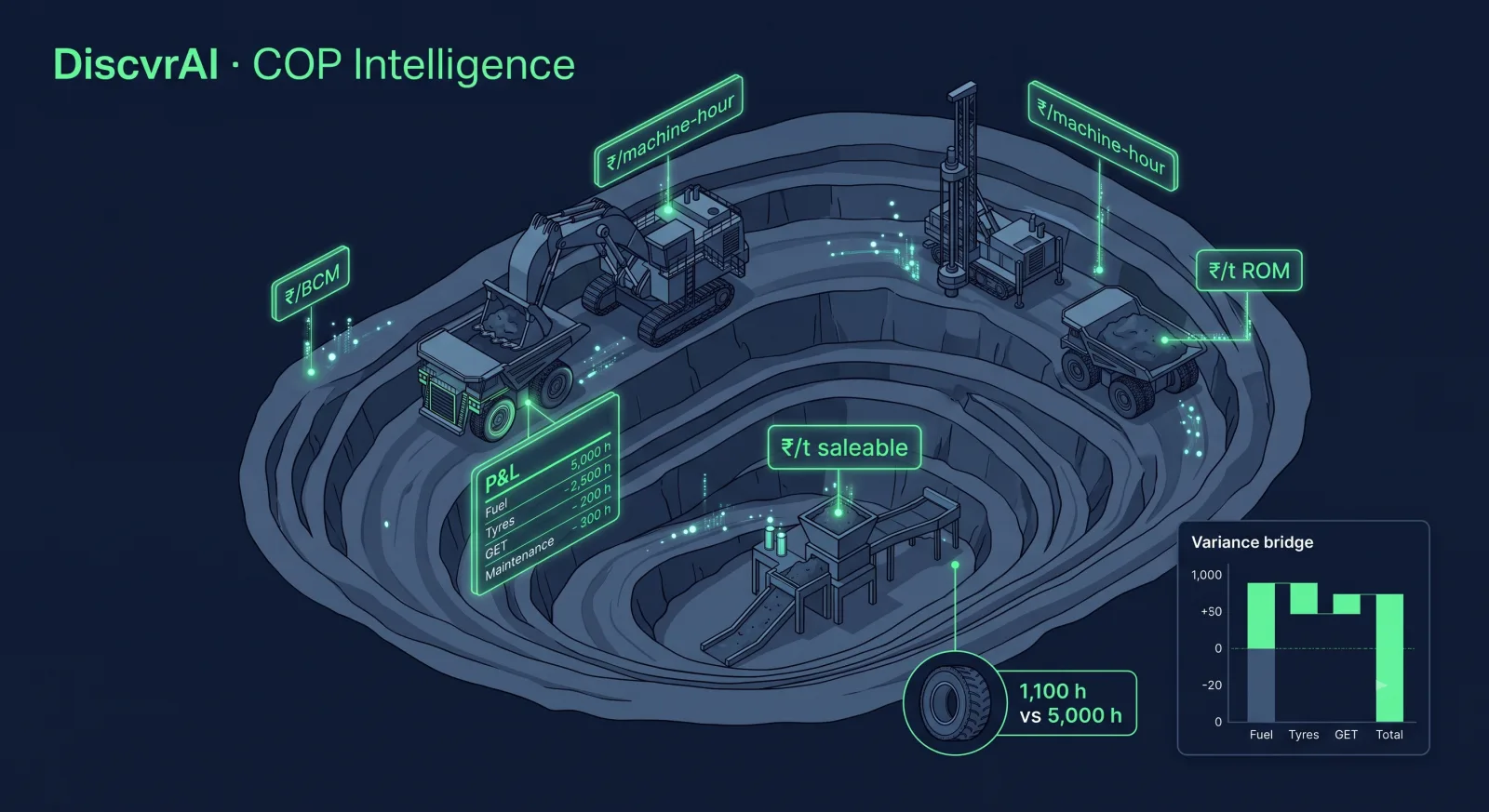
Steel COP is material-dominated, but mining COP is equipment-hour-dominated. The dominant cost is machines burning diesel and consuming components while moving volume, so the right primitive is cost per operating hour allocated to volume moved, not specific consumption × rate. Mining also has a joint-output problem: overburden removed and mineral extracted are produced together, so waste-movement cost must be allocated to saleable tonnes through the stripping ratio, under a capitalise-vs-expense treatment that is an accounting policy, not a calculation. OTR tyres booked as stores issues rather than cost-per-hour, engine overhauls spiking a single month, and lead creep as the pit deepens all stay invisible in a monthly cost MIS.
The captive-mine cost per tonne that flows into works cost as an assumed transfer price becomes a computed, reconciled number. Equipment cost stops hiding in stores issues and calendar-month spikes and becomes a per-machine P&L. The stripping-ratio, lead-creep and grade-slippage effects that a monthly MIS blends into one unexplained movement each get their own line in a residual-free bridge. For a contract miner, the cost variance that is their entire margin becomes visible and defensible.
How it works
The mining vertical holds four cost objects simultaneously: cost per BCM of overburden, per tonne of ROM, per tonne of saleable product, and per operating hour per machine, with explicit conversion between them. It reuses the platform's three-rate discipline (benchmark prices every dashboard, contract rate carries the month, actual invoice meets them only in the true-up, never blended) and its residual-free variance bridge, extended from four levers to ten so that stripping ratio, lead distance, availability and grade each isolate cleanly with no plug. Deferred stripping is held as a configured, versioned policy and computed on both bases with the delta shown. It is treated exactly like transfer pricing: tagged on every number, divergence surfaced, never silently picked.
- Step 1
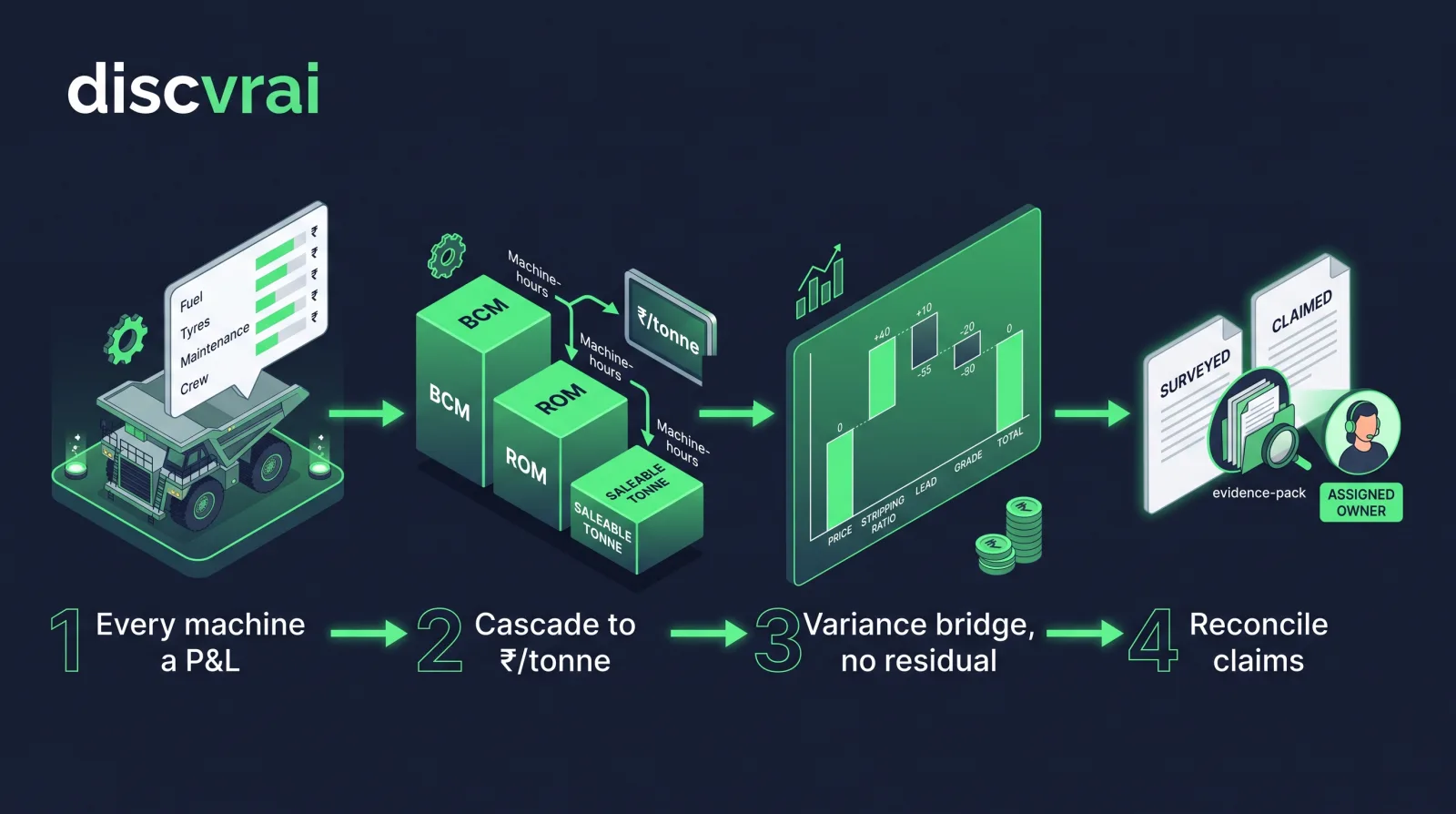
Give every machine a P&L
Each dumper, shovel, drill and dozer becomes a cost object with a rolling $/SMU-hour built up from fuel, lubricants, tyres, GET, planned and breakdown spares, MARC/CVA charge and amortised components. An engine overhaul is smoothed across the hours it serves, not spiked into the month it happened.
- Step 2
Cascade hours into cost per tonne
Machine-hours flow into cost per BCM and per ROM tonne, and stripping ratio and processing yield carry those into cost per saleable tonne. Components that wear by hours amortise on SMU, while components that wear by material moved amortise on tonnage. The most common mine-costing error is designed out.
- Step 3
Decompose the variance with no residual
Price, FX, usage, stripping ratio, yield, grade, lead distance, availability, volume and mix each isolate exactly and sum to total variance. If lead-creep and stripping effects can't be cleanly separated from usage, the bridge has a plug, so we prove it doesn't on your real data before the vertical is sold.
- Step 4
Reconcile contractor and levy claims
Surveyed vs claimed vs invoice-certified volume, owner-supplied diesel and explosives against work done, escalation clauses, and the full royalty, statutory levy and grade stack, each producing an evidence pack with source lineage and an assigned owner. The platform surfaces divergence and never silently picks a side.
Modules & sub-capabilities
Equipment Cost-per-Hour (CO-4)
The new build, and the one that makes the vertical defensible rather than a re-skin. It is a rolling, reconciled $/SMU-hour for every machine, with a PM-schedule engine (PM-1 to certified rebuild), component life and change-out plans, and availability/utilisation with the cost of idleness costed. It ships first as a standalone diagnostic: the tyre-life and deferred-PM findings alone justify a pilot in weeks.
Four Cost Objects & the Cascade
$/BCM of overburden, $/t ROM, $/t saleable, and $/machine-hour held at once, with explicit conversion. The default cost object matches the customer's own mental model: $/BCM for contractor-heavy operations, $/t for departmental mines.
Stripping & Deferred-Stripping Policy Layer
The customer's capitalise-vs-expense policy held as a versioned rule. COP is computed on both bases with the delta shown, plus a flag when actual stripping ratio deviates from life-of-mine average beyond a threshold, precisely when the treatment moves the reported number most.
Cost Pool Taxonomy
Drilling, blasting, excavation, haulage, auxiliary fleet, power, processing, manpower, stores, dispatch, levies and overhead, each a first-class object with its own rate source, file lineage and variance line. It includes the mine-to-mill link, fragmentation to downstream specific consumption, the single highest-value analytic in the vertical.
Physical Norms Library
Stripping ratio, specific diesel consumption (benchmark ~0.66 L/BCM), powder factor, yield, grade band, lead distance, OMS (output per man-shift, the metric every mine manager already recognises), tyre life and fragmentation P80, each carrying plan, actual, prior-year and benchmark into the bridge.
Statutory & Levy Rules Engine
Royalty, mineral development levies, sales and environmental taxes, forest NPV, closure provision and auction premium, configured and versioned like transfer-pricing rules, with effective dates. When statutory rates change mid-year, as they often do in mining, a versioned engine beats a hardcoded spreadsheet.
Grade Declaration & Realisation
Declared-vs-sampled grade variance valued end-to-end. It simultaneously reduces realisation and changes royalty and statutory levies, and nobody assembles it today because it spans quality, sales and finance with no single owner.
Contract & Operator Reconciliation
The cross-party layer where contract mining handles a growing share of production: surveyed vs contractor-claimed vs certified volume, owner-supplied diesel and explosives, rate and escalation application, deductions and idle/standby claims, each with an evidence pack and an assigned owner.
Trust & governance
The mining vertical inherits the steel deployment's discipline intact, because mining buyers are if anything more sceptical of software claims. Scope one pit or one section, not a whole complex. Run a historical replay on 3 to 6 months of file exports, with no live integration and no behaviour change. Then a parallel-run month against the mine's own cost sheet, with under 1% variance as a contractual gate rather than a demo claim. Only after the diagnostic pack lands, meaning computed COP on all four cost objects, the variance bridge, an equipment cost-per-hour ranking and a quantified top-ten cost-leak list with evidence, do live ingestion, alerts and governance follow.
Four cost objects, not one
| Cost object | Why it exists |
|---|---|
| $/BCM of overburden removed (CO-1) | The waste-movement cost base. Contractor rates, internal benchmarking and contract-miner billing are all denominated here. |
| $/tonne of ROM (CO-2) | Extraction cost before processing. |
| $/tonne of saleable product (CO-3) | The commercial number. It carries allocated overburden cost and absorbs yield loss, valued at realisation, not cost. |
| $/operating hour, per machine (CO-4) | The equipment cost primitive. Every machine has its own P&L. This is the new build. |
What a cost-per-hour model makes visible on day one
These leaks are invisible in a monthly cost MIS because the costs are booked against stores or the calendar month, not against the machine and the hours that consumed them.
The tyre gap
Published research on opencast mines found average OTR tyre life of ~1,100 hours against a projected 5,000. It is a material cost head, invisible while tyres are booked as stores issues.
Deferred-PM cost
Deferred preventive maintenance converts into breakdown cost at a quantifiable multiple. It is the argument that changes maintenance behaviour, provable only with cost-per-hour history.
Lead creep
As the pit deepens, haul distance grows structurally and quietly inflates COP year over year, almost never isolated in a monthly MIS. Isolating it is a headline first-pilot finding.
The overhaul artefact
An engine overhaul booked in the month it occurs shows a COP spike that is an accounting artefact, not an operational signal. Amortised across the hours it serves, the signal comes back.
The lube-to-fuel ratio
Lubricants booked as stores issues hide a ratio that is one of the earliest signals of both failing fleet health and diesel pilferage. Computed per machine, an abnormal ratio surfaces the problem before the breakdown or the shortfall does.
The cost of idleness
A machine that is available but not running still accrues owning cost every hour. Idle-but-available time is rarely costed, so the fleet that looks cheapest on a monthly sheet can be the most expensive per tonne actually moved.
What genuinely carries over, and what is new engine work
Most of the platform transfers to mining unchanged. Two structural differences are real new build, and the honest split keeps the roadmap from being costed as a re-skin.
Reuse as-is
Ingestion, reconciliation workbench, lineage, three-rate discipline and true-up, alerts, governance loop, board packs, and the Power BI semantic layer.
Configure & extend
Stage cascade, cost-pool taxonomy and physical norms are configuration. The levy engine extends the transfer-pricing rules engine, and the bridge extends from four levers to ten.
New build: CO-4
The equipment cost-per-hour module. High effort, highest value, most self-contained, and shipped first as a standalone diagnostic.
New build: allocation
The stripping allocation and deferred-stripping policy layer, contract-miner reconciliation and the grade-declaration module.
“Steel COP is material-dominated. Mining COP is equipment-hour-dominated. Get that wrong and the vertical sinks.”
The one thing that does not carry over
We ingest, we don't rebuild your fleet stack
COP Intelligence is the reconciled cost and attribution layer above your operational systems, the same posture as "keep Power BI, feed it truth." In scope to ingest: SAP PM, OEM telematics (VisionLink, KOMTRAX), fleet-management systems (Wenco, Modular, MineStar), OITDS truck-dispatch, fuel-sensor platforms, oil-analysis results, workshop job cards and MARC/CVA vendor billing. Explicitly out of scope: building fleet dispatch, telematics hardware or blast design, because Orica, MineExcellence and the FMS vendors own those layers and do them well.
Ship the equipment diagnostic first, prove it in six weeks.
The full COP cascade is months of domain calibration. The cost-per-hour diagnostic needs only maintenance and fuel data and produces a quantified finding in your local currency within weeks. If CO-4 can't sell on its own, the full vertical won't either, and you'll know in six weeks, not nine months.
What we need from you
- • One pit or one section, not a whole complex
- • 3-6 months of maintenance, fuel and dispatch feeds as file exports
- • Your deferred-stripping policy, and whether you cost per BCM or per tonne
What you get at the end
- • Computed COP on all four cost objects, with the variance bridge
- • An equipment cost-per-hour ranking across the fleet
- • A quantified top-ten cost-leak list with evidence: tyres, deferred PM, lead creep
Weeks 1-2
Onboard maintenance & fuel feeds, build CO-4
Weeks 3-4
Cost-per-hour ranking, plus top cost leaks
Weeks 5-6
Parallel-run against your cost sheet, <1% gate
Agents deployed for this module
These are the named agents we deploy when COP Intelligence - Mining is the production module for your business problem. Each agent is a job we deploy for you. You do not buy software and install it yourself.
See all agents we deployYou might also need
Related insights
Predictive Maintenance Is Old. Agentic Maintenance Is the New Opportunity
Predictive maintenance stops at flagging risk, it doesn't act on it. Agentic maintenance converts a machine alert into a structured, actionable maintenance card that coordinates inventory, production and approvals, turning prediction into governed execution.
Read article · 6 min →Manufacturing & FMCGFrom Dashboards to Decisions: How Agentic AI Can Transform Manufacturing Operations
Manufacturers already have plenty of data, what they lack is speed of decision, since choices stay fragmented across systems and teams. Agentic AI works best as an execution layer on top of existing ERP, starting with one bounded workflow and a human-in-the-loop approval gate.
Read article · 6 min →Manufacturing & FMCGWhen the Kiln Already Knows It's About to Fail
Plants already generate the data needed for predictive maintenance and quality improvement, in historians, MES and SCADA systems, without needing new sensors. Physics-aware anomaly detection, remaining-useful-life models, computer vision and time-series forecasting turn that existing data into decisions inside the workflows planners already use.
Read article · 6 min →Get in touch
Frequently asked questions
No. Steel COP is material-dominated, with 70 to 80% of the number flowing through specific-consumption × rate. Mining COP is equipment-hour-dominated, so the correct primitive is cost per operating hour allocated to volume moved. That equipment cost-per-hour module, plus the stripping-allocation and deferred-stripping layer, are genuine new engine work, not configuration.
Cost per BCM of overburden, per tonne of ROM, per tonne of saleable product, and per operating hour per machine. Contractor rates and contract-miner billing are denominated in $/BCM, the commercial number is $/t saleable, and the equipment primitive is $/machine-hour. The platform holds all four at once with explicit conversion between them.
It turns every machine into a cost object with a rolling $/SMU-hour, so costs booked today as stores issues or calendar-month spikes become attributable. That makes the tyre-life gap (observed ~1,100 hours against a projected 5,000), deferred-PM-turned-breakdown cost, and lead creep visible, often on day one.
It's a policy, not a calculation. We hold your capitalise-vs-expense policy as a configured, versioned rule, compute COP on both bases, show the delta explicitly, and flag when actual stripping ratio deviates from the life-of-mine average beyond a threshold, the moment the treatment moves the reported number most. It's treated exactly like transfer pricing: tagged, surfaced, never silently picked.
That is the non-negotiable property carried over from steel. Price, FX, usage, stripping ratio, yield, grade, lead distance, availability, volume and mix each isolate cleanly and sum to total variance. If lead-creep and stripping effects can't be separated from usage, the bridge has a plug and the core claim is broken, so we prove it on your real data before the vertical is sold.
No, we're the reconciled cost and attribution layer above them. We ingest SAP PM, OEM telematics, FMS, OITDS, fuel-sensor and MARC/CVA billing. Building fleet dispatch, telematics hardware or blast design is explicitly out of scope, since Orica, the FMS vendors and MineExcellence own those layers.
Yes, and we recommend it. Ship the equipment cost-per-hour diagnostic first, on one pit or section, using only maintenance and fuel data, for a quantified finding in your local currency in about six weeks. The full COP cascade follows once the account is open and the parallel-run clears the under-1% gate.
Yes, arguably more so. For a contract miner, cost per tonne is gross margin, and you have no internal BI empire to defend. The reconciliation module is neutral by design: mine owners and contract operators want opposite things from it, so we build for one side first and surface divergence without picking a side.